- Non-invasive, quick and easy to perform24
- Shows patient’s response to treatment, enabling the correct prescription of medication and safer/monitored adjustments25.
- Aids in identifying patients who do/do not require on-going treatment25.
What is FeNO?
Nitric oxide (NO) is a gas produced by cells involved in the inflammation associated with allergic or eosinophilic asthma, measured in parts per billion (ppb) in the air you slowly exhale out of your lungs (1).
The FeNO (Fractional exhaled Nitric Oxide) device can be used for the detection and management of inflamatory airway conditions such as asthma16, but also to differentiate between COPD, ACOS other and interstitial lung diseases that are not assessed by other means, such as lung function2.
The FeNO (Fractional exhaled Nitric Oxide) device can be used for the detection and management of inflamatory airway conditions such as asthma16, but also to differentiate between COPD, ACOS other and interstitial lung diseases that are not assessed by other means, such as lung function2.
Airway inflammation is a central process in asthma17. Being able to detect eosinophilic airway inflammation and monitor a patient’s response to treatment is regarded as a gold standard in the management of respiratory diseases. Nitric oxide measurement is not intended as a stand-alone method for diagnosis and should be used in conjunction with other evaluation methods and tests18. Using FeNO measurements to evaluate airway inflammation in asthma represents a significant advance in respiratory medicine (1), but until now this has been an expensive test to deliver in everyday practice.
FeNO Measuring in Asthma Care
According to Asthma Lung UK, 7.2 million people have asthma. This is about 8 in every 100 people¹⁹. Approximately 5.4 million people are currently recieving treatment for asthma in the UK, 4.3 million of whom are adults²⁰ and approximately 363 million individuals worldwide are thought to be affected by asthma²¹. Sadly, four people die every day in the UK because of asthma attacks, and two out of three asthma deaths are considered preventable.¹⁹ Asthma is conservatively estimated to cost the UK public sector at least £1.1 billion each year.²⁰
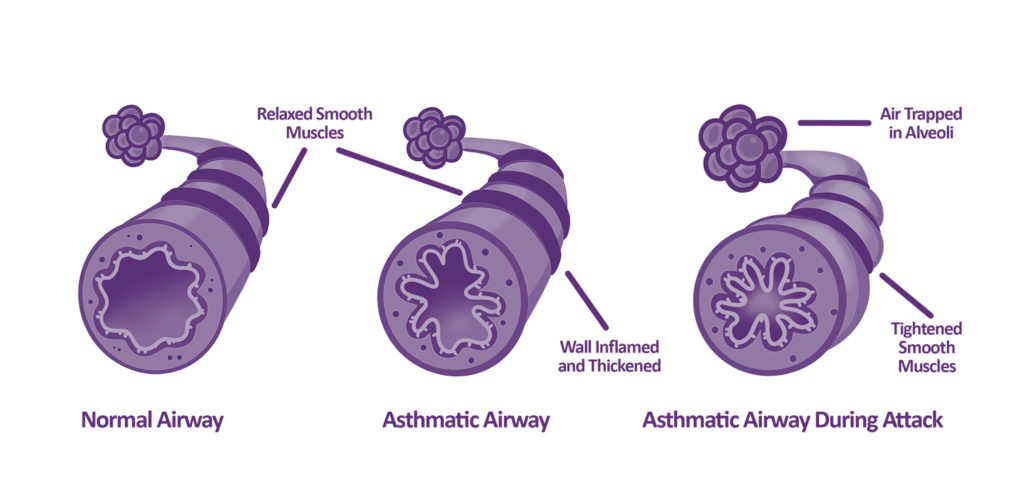
Asthma is a chronic lung disease that affects people of all ages. It is caused by inflammation and tightening of the muscles surrounding the airways, making it more difficult to breathe²¹. Airway eosinophilic inflammation is a characteristic feature of asthma.This can be assessed directly by measurement of eosinophils and eosinophilic cationic protein (ECP) in sputum, or ECP’s can be measured in a blood sample²².
FeNO breath testing conforms to NICE/BTS/SIGN guidelines as an aid to diagnose allergic asthma. Literature also suggests the ability for FeNO measurement to be used as good management tool for asthma, assessing the effectiveness of patients allowing a personalised approach²³.
Benefits of FeNO use
- Shows patient compliance25.
- Aids in differentiating between allergic (eosinophillic) and non-allergic asthma25.
- Shown to be superior to the majority of conventional tests of lung function, such as peak flow recording and spirometry26.
For a list of references for all of our pages, please see this page.